ERW Tube Mill Pricing in Mexico, Brazil & Colombia: 2026 Buyer’s Guide
ERW tube mill pricing is not a single number, and any supplier who quotes you a figure without first asking detailed questions about your production requirements should immediately raise a flag. The price of an ERW tube mill is determined by a combination of factors — mill size and OD range, wall thickness capability, automation level, roll tooling scope, commissioning terms, freight and import costs, and the engineering quality behind the machine — and two quotes at the same headline price can represent radically different total investments once you account for all of them.
We sell regularly into the Mexican, Brazilian, and Colombian markets, and the pricing questions we hear from buyers follow predictable patterns. Buyers who understand how ERW tube mill pricing is structured make better procurement decisions than those who evaluate equipment on headline capital cost alone. This guide breaks down what you can expect to pay by mill type and size in 2026, what drives variation, and what costs are routinely underestimated when building the initial project budget.
How to Think About ERW Tube Mill Pricing
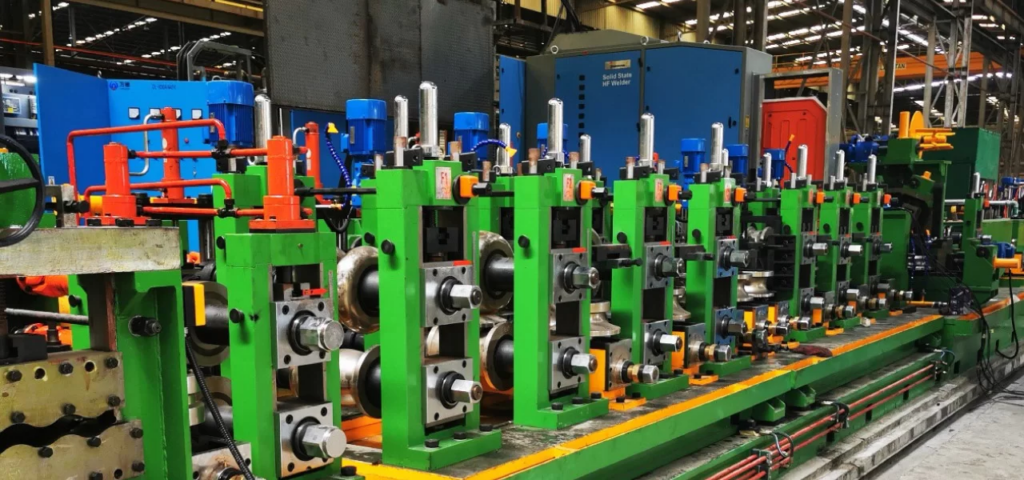
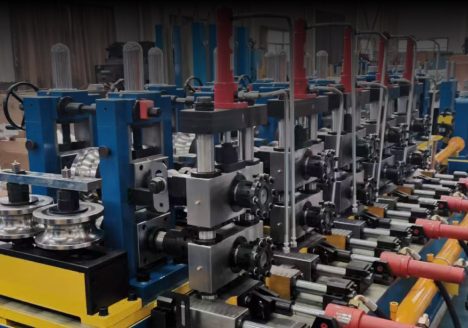
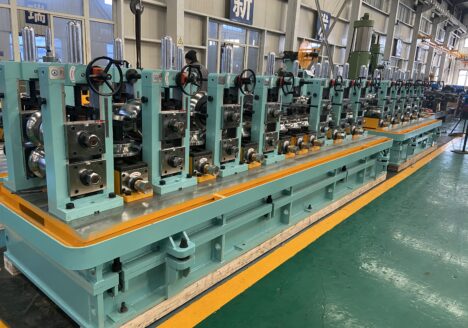
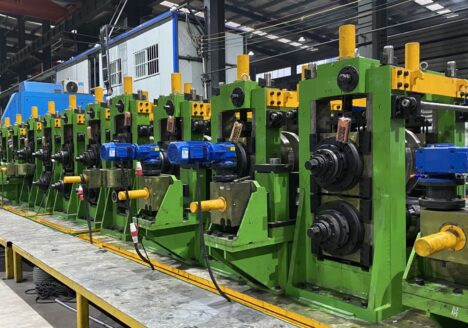
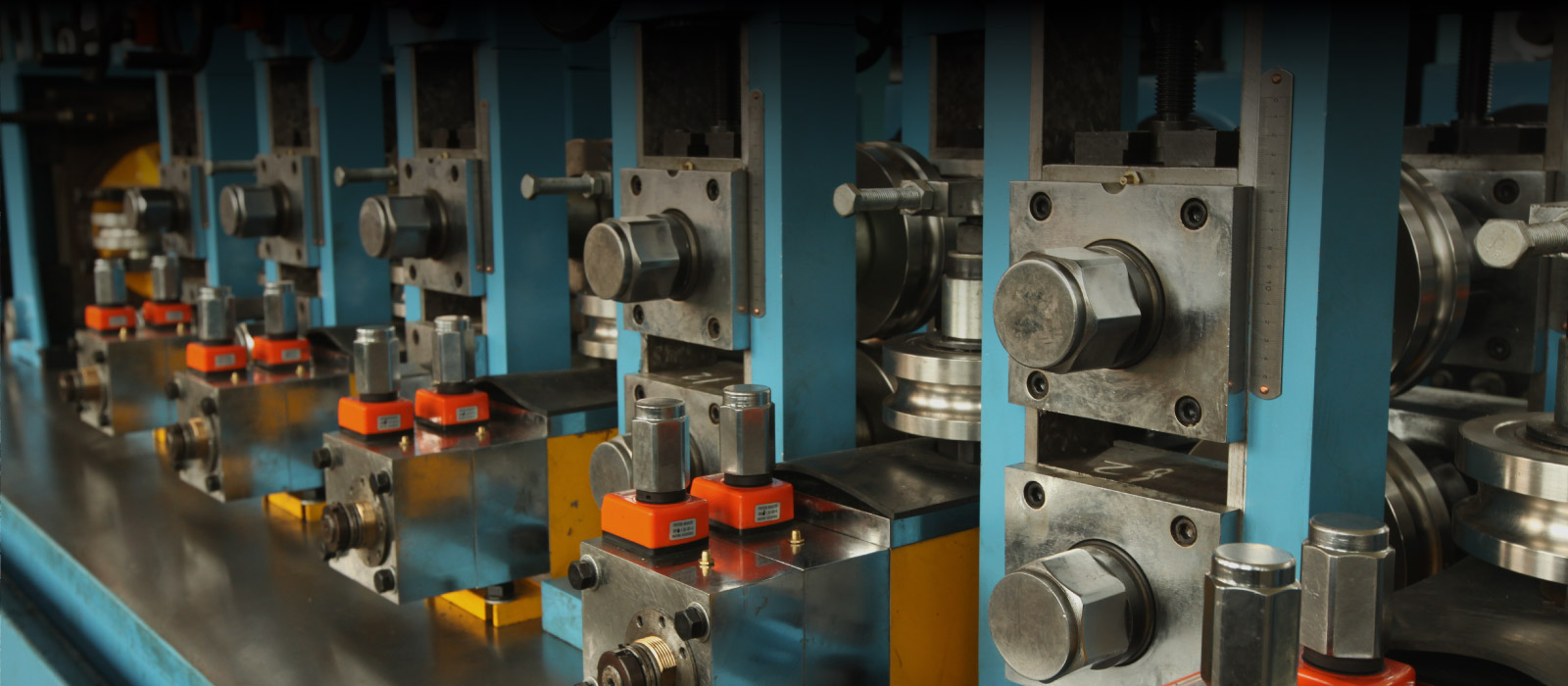
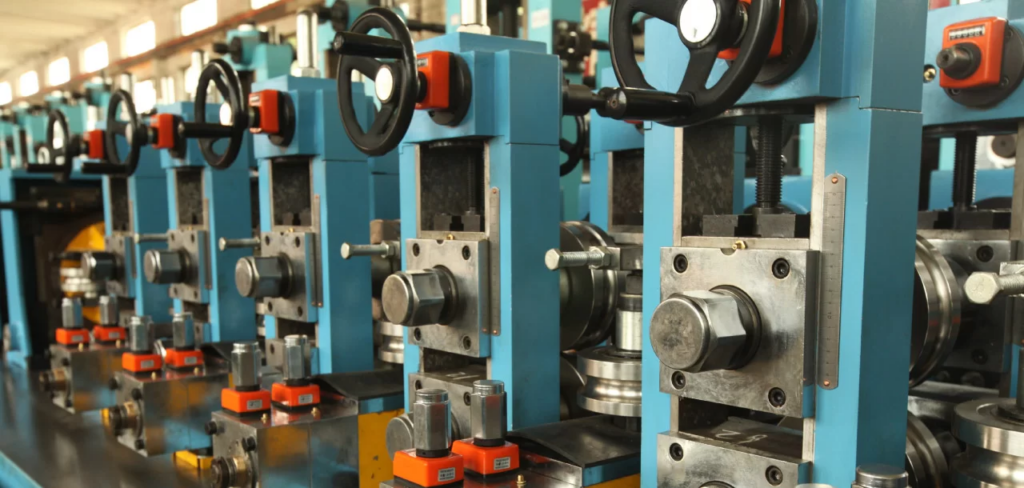
Before looking at specific price ranges, it helps to internalize the right frame. An ERW tube mill is a system, not a single piece of equipment. The complete line typically includes a decoiling and strip feeding section, a forming section with multiple roll passes, a high-frequency induction welding unit, an internal bead removal tool, a cooling and sizing section, a straightening section, and a flying cutoff saw. Each element has its own cost driver, and the configuration of each section for your specific application affects the total system price.
Beyond the equipment itself, a complete tube mill purchase involves tooling — the forming and sizing roll sets for your product range — commissioning, freight, import duties, site preparation, and spare parts inventory. All of these belong in your budget before you can make a meaningful cost comparison between suppliers.
The most useful frame for evaluating ERW tube mill pricing is total cost of ownership over the first five years of operation, not capital cost on day one. A mill that is $150,000 cheaper upfront but requires $80,000 in additional tooling, runs at a much lower than expected efficiency due to high reject rate and machine downtime, and requires two unplanned maintenance trips from the factory at $25,000 each is not a cheaper mill. Do the math before you sign.
ERW Tube Mill Price Ranges by Size and Type — 2026
The following ranges reflect complete line pricing from us as the manufacturer, including the forming section, weld box, sizing section, flying cutoff, standard control system, and a base roll set configured for one tube profile. Freight, import duties, installation infrastructure, and optional automation upgrades are not included.
High-Speed ERW Tube Mills — Small Diameter
Our small-diameter high-speed mills — the ERW32 and ERW38 — target the furniture, racking, light construction, and small-diameter industrial tube market. Complete line pricing typically ranges from USD $180,000 to $390,000 at standard automation level. This is the most competitive price segment, with the most supplier options, and also the segment where quality variation between suppliers is widest. Buyers here should weight roll tooling quality and weld box design heavily in the evaluation rather than leading with price.
For Mexican buyers specifically, the nearshoring-driven furniture and racking manufacturing expansion has created active, consistent demand at this specification level. Production speeds on well-configured small-diameter mills can reachup to 160 meters per minute for light-gauge round tube, making them capable of high daily output volumes in a two-shift operation.
High-Speed ERW Tube Mills — Mid-Range
The mid-range — our ERW60, ERW76, ERW89, ERW114, and ERW168 — is the most active segment for Latin American buyers and drives the majority of the region’s structural hollow section and general construction tube production. Complete line pricing ranges from approximately USD $350,000 to $1,800,000 depending on OD, wall thickness capability, and automation level.
The ERW89 is particularly significant for Mexican and Brazilian construction markets. At 89mm OD maximum with wall thickness capability up to 5 to 6mm depending on configuration, it covers the majority of structural hollow section requirements for mid-rise construction, industrial framing, and infrastructure applications. If you are setting up a tube production operation to serve the Mexican or Brazilian construction sector, the ERW89 or ERW114 is almost certainly the right starting specification for your product mix.
High-Speed ERW Tube Mills — Large Diameter
Our large-diameter mills — the ERW219, ERW325, ERW508, and ERW630 — serve structural piling, large-bore infrastructure, and heavy construction applications. These are more complex systems with longer lead times. Complete line pricing ranges from approximately USD $1,700,000 for the ERW219 through to USD $8,500,000 or more for a fully configured ERW630.
For Latin American buyers, large-diameter mills are most relevant to Brazilian buyers serving infrastructure and offshore supply chains and to buyers targeting civil engineering and structural piling applications across the region. Lead times on large-diameter mills are typically 24 to 48 weeks from order confirmation to delivery, and commissioning is more complex — these projects require longer planning horizons than standard mid-range installations.
The Variables That Drive Price Variation
Automation Level: The Single Biggest Driver
Automation level is the variable that most dramatically affects the price of any given ERW tube mill, and it is the variable that buyers most often fail to align correctly with their operating context. A basic mill with manual coil handling, manual pass adjustment, and simple HMI control can cost 35 to 50 percent less than the same mill equipped with an automatic coil car and threading system, powered pass adjustment with position feedback, full PLC with production data logging, automatic length counting and sorting, and integrated quality monitoring.
In Mexico, where manufacturing labor costs are lower than in Brazil and significantly lower than in the United States or Europe, there is often a strong economic case for lower automation levels on smaller mills. In Brazil’s higher-labor-cost industrial centers — or for operations running continuous three-shift production — the payback calculation on automation investment looks very different. Work through the numbers for your specific context before deciding.
Roll Tooling Scope
The base price of most ERW tube mills includes a single roll set configured for one tube profile, typically a specific round OD. If you plan to run square and rectangular hollow sections as well, or multiple round ODs, you need additional roll sets — and this is where some suppliers generate significant margin on what appears to be a competitive base price.
Always ask for an itemized price for the complete tooling inventory you actually need for your planned product range, then add that to the base mill price before comparing suppliers. We supply spare parts and tooling with transparent pricing and will include a complete tooling cost estimate in any quotation.
Commissioning Scope and Location
Commissioning an ERW tube mill in Latin America involves travel from the manufacturer’s engineering team, time on-site to set up and qualify the mill, consumable strip for production trials, and operator training. A full commissioning program in Mexico or Brazil typically adds USD $18,000 to $50,000 to the project cost, depending on mill size, product range complexity, and your facility location.
Some suppliers include commissioning in the base price; others quote it separately; others provide a price that includes travel and accommodation but not on-site time beyond a fixed number of days. Get the complete commissioning scope in writing and understand specifically what happens if the mill fails to reach acceptance criteria during the scheduled commissioning period.
Freight and Import Costs
ERW tube mills from manufacturers attract import duties in Latin American markets. In Mexico, manufacturing machinery typically falls under a 5 to 10 percent import duty rate, though specific rates depend on the equipment classification and origin. Brazil has a more complex import duty structure with ICMS and IPI applying in addition to base import duties, which can add meaningfully to the landed cost. Colombia and Chile have lower duty environments, with trade agreement provisions reducing rates for some equipment origins.
Always calculate your total landed cost — CIF port of entry plus import duties plus inland freight to your facility — before comparing supplier prices on an ex-works or FOB basis. A mill that appears $80,000 cheaper at origin can be cost-equivalent or more expensive once landed at your facility in Monterrey, São Paulo, or Bogotá.
Engineering Quality and Supplier Origin
The price differential between manufacturers at different engineering quality levels is real and persistent. The differential reflects genuine differences in engineering investment, tooling precision, quality control consistency, and after-sales support infrastructure. In a high-volume tube production operation running two or three shifts, the production efficiency difference between a well-engineered mill and a poorly-engineered one is measurable and compounds over time. Weld seam consistency, dimensional tolerance maintenance as tooling wears, roll life, and unplanned downtime frequency all differ between quality levels. The accumulated cost of that difference over 10 to 15 years of operation typically exceeds the initial capital cost differential many times over.
Hidden Costs Latin American Buyers Routinely Underestimate
- Spare parts inventory at commissioning. A well-managed ERW tube mill operation holds a planned spare parts inventory — typically 60 to 90 days of critical component requirements — from the day production starts. This inventory has a cost that belongs in your project budget. Failing to plan for it means your first emergency spare parts order arrives on a crisis timeline, often from overseas, at a premium price and with a production stoppage you cannot afford.
- Roll regrinding infrastructure. Forming rolls wear over time and require periodic regrinding to maintain tube quality. Understand whether regrinding can be done locally in-region or requires shipment back to the manufacturer. Local regrinding is faster, cheaper, and keeps your roll inventory in-region. This affects your ongoing tooling cost and mill availability across the operational life of the equipment.
- Electrical and civil infrastructure. ERW mills require dedicated electrical supply with specific voltage, frequency, and capacity requirements, and precision-poured concrete foundations. Site preparation costs are project-specific but can add USD $30,000 to $150,000 to the total project cost depending on your facility’s existing infrastructure. Budget for them explicitly.
- Operator training. Operators who understand how the mill works — not just how to push buttons, but why adjustments affect weld quality and how to recognize early signs of tooling wear — produce better tube with less downtime. Budget for training as a specific line item, not an afterthought.
How to Ensure You Are Comparing Suppliers Fairly
The most common source of confusion in ERW tube mill procurement is comparing quotes that are not actually comparable. Supplier A quotes $420,000 including commissioning, one roll set, and freight to port. Supplier B quotes $380,000 excluding commissioning, with tooling for only one profile, freight not included. These are not comparable quotes, and treating them as equivalent leads to bad decisions.
To get genuinely comparable quotes, require every supplier to quote on the same scope: the same OD range, wall thickness capability, production speed target, roll tooling inventory, commissioning program scope, and delivery point. Add freight and import duty estimates to each quote to arrive at a comparable landed cost. We quote transparently and will itemize every component of the price so you know exactly what you are comparing.
For complete pricing on any of our ERW tube mills for Latin American installation, contact our team at frvtubemill.com.au/contact-us with your full production specification and we will provide a detailed quotation within five business days. For buyers evaluating our full Latin America ERW tube mill range, our technical team is available to discuss specification questions before you formalize your inquiry.