Eastern Europe’s Manufacturing Rise: ERW Tube Mill Demand in Poland and Romania
Eastern Europe’s industrial transformation is one of the most consequential shifts in European manufacturing over the past two decades, and it has accelerated meaningfully since 2020. Poland and Romania — the two largest Eastern European economies and the most active ERW tube mill markets in the region — are no longer peripheral manufacturing locations. They are integral, growing nodes in the European industrial supply chain, and the infrastructure investment, automotive expansion, and energy development happening across both countries is creating sustained, durable demand for ERW tube mill equipment that we expect to continue well beyond the current EU programming period.
This article covers what is actually driving ERW tube mill demand in Poland and Romania, which industries are buying and why, what standards compliance looks like in these markets, and what the competitive landscape means for buyers evaluating ERW tube mill suppliers for Eastern European installations.
Poland: Why It Has Become One of Europe’s Most Active Tube Mill Markets
Poland is the largest economy in Central and Eastern Europe, the sixth-largest in the EU, and has sustained GDP growth that has outpaced the European average for most of the past 30 years. Its manufacturing sector is broad, deep, and increasingly sophisticated — and it is growing faster now than at any point since EU accession in 2004. Several converging forces are driving ERW tube mill demand specifically:
EU Cohesion Fund Infrastructure Investment
Poland is one of the largest recipients of EU structural and cohesion funds in Europe. The 2021 to 2027 programming period allocated approximately PLN 76 billion — roughly EUR €16 billion — to Poland across cohesion, just transition, and development funds. A significant portion is directed at transport infrastructure. Poland’s motorway and expressway network is still expanding, with hundreds of kilometers of new road under construction or in planning at any given time, alongside major rail modernization programs, energy infrastructure upgrades, and urban development in the country’s major economic centers.
Infrastructure construction at this scale generates direct and substantial demand for structural steel tube. Bridge components, tunneling supports, rail infrastructure elements, urban safety barriers, lighting mast structures, and the steel framing of infrastructure buildings all rely on ERW structural hollow sections. That demand flows directly to tube producers, who respond by expanding capacity on existing lines or investing in new ERW tube mill equipment. We have seen this demand reflected clearly in the inquiries we receive from Polish buyers, particularly from the Silesia, Greater Poland, and Masovian industrial regions where steel production and processing capacity is most concentrated.
Automotive Manufacturing Expansion
Poland’s automotive industry is one of the most important in Central Europe. Volkswagen Poznań, Toyota’s manufacturing complex in Wałbrzych — the largest Toyota plant outside Japan by employee count — Stellantis operations in Gliwice, and a dense network of tier-1 and tier-2 component suppliers across the country collectively make Poland a major center of European automotive production. The country produces approximately 500,000 vehicles per year and a significantly larger volume of automotive components for export into the broader European supply chain.
Automotive manufacturing is one of the most demanding end markets for ERW tube mill equipment. Seat frame tubing, roll cage and safety structure components, exhaust system tube, chassis reinforcement elements, and fluid line tubing all require precise dimensional tolerances and consistent mechanical properties that a standard high-speed construction mill cannot reliably deliver. Our precision tube mill is specifically engineered for these applications — tighter forming and sizing tooling tolerances, enhanced process control, and production documentation capability that satisfies automotive quality management requirements including IATF 16949-aligned traceability.
Polish automotive component producers investing in tube production capability for the automotive supply chain are specifying precision mills. The price premium over standard high-speed equipment is real but justified by the market access it enables and the quality requirements it consistently satisfies.
Construction and Residential Development
Poland has sustained strong construction activity across commercial, residential, and industrial segments for most of the past decade. Warsaw, Kraków, Wrocław, Poznań, and Tri-City have seen sustained development that continues to drive structural hollow section demand. Polish tube producers serving the domestic construction market are largely focused on the mid-range — square and rectangular hollow sections in the 40×40mm to 150×150mm range, primarily carbon steel to EN 10219 specification.
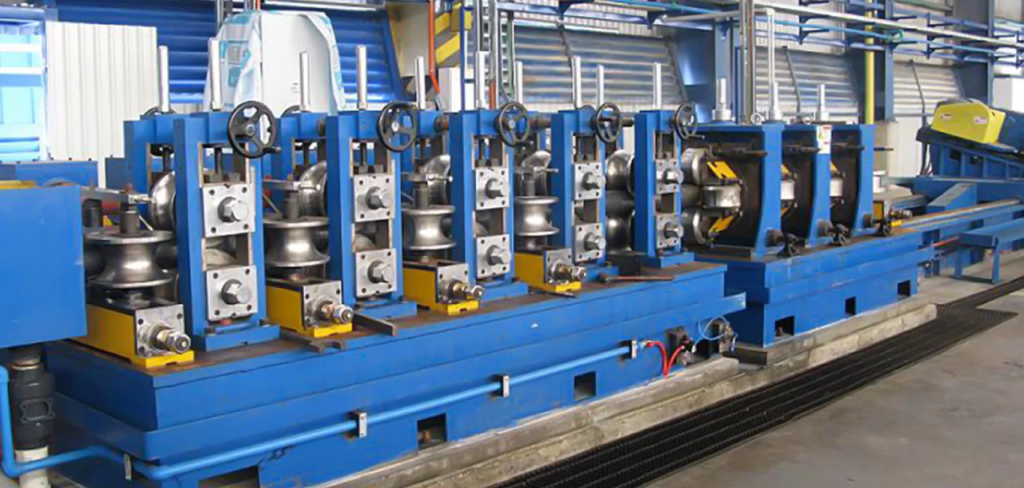
Our ERW89 and ERW114 mills are the most common specifications for this application in the Polish market. Both provide the OD range, wall thickness capability, and production speed needed to serve the structural hollow section market competitively, and both can be configured with our quick change technology to reduce profile changeover time for producers running multiple SHS and RHS dimensions.
Poland as an Export Platform for Western European Markets
One dynamic that distinguishes Poland from other Eastern European tube markets is that Polish producers are not only serving the domestic market. Poland’s geographic position — central in Europe, with strong logistics infrastructure and EU single market access — makes it a viable export platform for structural tube into Germany, Czech Republic, Austria, and the wider EU. Polish producers who can certify to EN 10219, produce competitive quality, and deliver reliably into Western European supply chains are operating in a much larger addressable market than their domestic-only peers.
This export orientation raises the bar on equipment quality requirements. EN 10219 compliance documentation, consistent dimensional performance, and the quality management infrastructure to satisfy Western European buyer requirements are prerequisites for operating in this market. Our mills and the compliance support we provide are specifically designed to meet these requirements.
Romania: Energy, Infrastructure, and a Growing Automotive Base
Romania is the second-largest economy in Eastern Europe and has been one of the fastest-growing in the EU for the past decade. The country’s ERW tube mill market is shaped by a specific combination of energy sector development, EU-funded infrastructure investment, and a significant automotive manufacturing industry that has been expanding for two decades.
Energy Sector: Romania’s Most Distinctive Market Driver
Romania has one of the most significant domestic energy production bases in the EU. The country holds the second-largest oil and gas reserves in Europe after the Netherlands, operates a substantial refining and petrochemical industry, and has an offshore Black Sea development program that represents one of the most significant energy investments in Europe over the next decade.
The Neptun Deep project — operated by Romgaz and OMV Petrom in the Romanian Black Sea — involves a multi-billion euro investment in deep-water gas development that will require substantial quantities of subsea pipeline, structural steel for offshore platforms, and onshore processing infrastructure. The API 5L line pipe and structural tube requirements of a project at this scale are significant, and Romanian domestic producers who can supply to API specification represent a strategically important part of that supply chain.
Our API tube mill is directly relevant for Romanian buyers considering investment in API-rated tube production for the energy sector. This is not a standard mill marketed as API-capable — it is a mill specifically engineered to meet API 5L requirements under production conditions, with the weld box design, sizing section capability, and non-destructive testing integration that genuine API compliance requires.
Beyond Neptun Deep, Romania is investing heavily in renewable energy. Wind development in the Dobrogea region and offshore wind projects in the Black Sea create structural tube requirements for turbine towers, foundation structures, and grid connection infrastructure. Our ERW219 and ERW325 are well-suited to the structural hollow section requirements of wind energy infrastructure.
EU Cohesion Fund Investment in Infrastructure
Romania’s allocation from EU cohesion and structural funds for the 2021 to 2027 period exceeds EUR €31 billion — among the highest of any EU member state relative to GDP. The investment is directed primarily at transport infrastructure, municipal development, and energy transition projects. Romania’s motorway network is significantly underdeveloped relative to Western European standards, and the EU-funded construction program to address this gap is one of the largest active infrastructure investment programs in Europe. Motorway construction, bridge building, and tunnel engineering at this scale generate substantial structural tube demand.
Romanian tube producers are actively expanding capacity to capture this opportunity, and the inquiries we receive from Romanian buyers reflect investment in mid-range and large-diameter mill capacity specifically oriented toward the infrastructure construction market. Our ERW168 and ERW219 are the most relevant specifications for Romanian buyers targeting infrastructure construction demand.
Automotive Manufacturing: Dacia and the Tier Supply Chain
Dacia — the Renault Group’s Romanian brand and one of Europe’s fastest-growing automotive manufacturers — operates its primary manufacturing facility in Mioveni, employing approximately 15,000 people and producing over 300,000 vehicles per year. Dacia’s consistent growth, driven by the success of its Duster, Sandero, and Spring models in European markets, has pulled significant tier-1 and tier-2 supplier investment into Romania.
The automotive component manufacturing surrounding the Dacia plant generates demand for precision tube for seat frames, body reinforcement, and fluid management systems. As the Romanian automotive supply chain matures and supplier capabilities expand, there is growing interest in in-house tube production among component manufacturers currently buying from external suppliers. Our precision tube mill and small OD heavy gauge mills are the relevant specifications for this market segment.
Standards and Compliance Requirements in Eastern Europe
Eastern European buyers operate within the European standards framework, which means EN standards apply as the baseline for most applications. However, the compliance picture is more nuanced than in Western Europe.
- EN 10219 is the core standard for cold-formed welded structural hollow sections across both markets. Any structural hollow section entering the European construction supply chain — whether sold domestically in Poland or Romania or exported into Western European markets — must comply. Our mills are configured to support EN 10219 production and we provide documentation packages that support factory production control certification.
- EN 10217 governs welded steel tubes for pressure applications. For Romanian buyers targeting the energy sector infrastructure market, EN 10217 compliance for relevant pressure range applications is a hard procurement requirement.
- Legacy STAS standards in Romania deserve specific mention. Romanian industrial procurement, particularly in the energy and heavy industry sectors, sometimes references STAS standards inherited from the pre-EU period. STAS 404 and related standards still appear in some procurement specifications for refurbishment and maintenance projects in existing oil and gas infrastructure. Confirm which standard applies to your specific application rather than assuming EN standards apply universally.
- CE marking under EN 1090-1 applies to structural steel products entering the European construction market. For Polish producers exporting into Western Europe, CE marking is a hard requirement. As both markets continue converging with Western European standards practice, CE marking infrastructure is increasingly becoming a prerequisite for accessing the better-quality segments of both domestic markets as well.
The Competitive Landscape: What Eastern European Buyers Are Actually Choosing
Eastern Europe is genuinely contested ground between Chinese manufacturers and manufacturers with deeper engineering histories and European support infrastructure, and we think it is important to be direct about the competitive dynamics.
The Eastern European market has matured significantly, and buyers today are evaluating suppliers on engineering depth, compliance capability, and after-sales support rather than on price alone.
The factors that consistently push buyers toward our equipment are:
- Weld quality consistency over time. The consistency of weld seam quality across a full production run, and across months and years of operation as tooling wears, is where the engineering quality differential between suppliers shows most clearly. Inconsistent weld quality in structural hollow sections creates certification and liability problems in the European construction supply chain that are expensive to resolve after the fact.
- Tooling life and regrinding precision. Our roll sets last longer and can be reground to tighter tolerances than what we consistently see from lower-cost alternatives. For Polish and Romanian buyers running two or three shifts, this translates to lower ongoing tooling cost and better mill availability across the operational life.
- Support response times. When a production line stops, the speed of the support response has direct financial consequences. Our European service coordination means parts and technical support are accessible on European timescales, not dependent on a factory on another continent. This matters most at 2am on a Tuesday when your mill has stopped and you have a production commitment to meet.
- EU funding compliance requirements. For buyers purchasing equipment on EU cohesion fund financing, documentation and audit requirements attached to that funding create pressure for credible supplier quality systems. Equipment purchased with EU fund support is subject to periodic audit, and these requirements favor suppliers with established, documented quality management processes.
What Eastern European Buyers Should Do Before Approaching Suppliers
The buyers who make the best ERW tube mill procurement decisions in Eastern Europe consistently do the same things. They define their product range — the specific ODs, wall thicknesses, and profiles they plan to produce — before approaching any supplier. They identify which standards apply to their specific end market. They calculate their production volume requirements and shift pattern to determine the correct automation level. And they account for total cost of ownership, including tooling, maintenance, spare parts, and support, rather than evaluating on capital cost alone.
We strongly recommend visiting reference installations in the region before committing to a purchase. We can facilitate reference visits to installations in comparable Eastern European markets. Seeing a mill running at production capacity, talking to operators and maintenance staff about their experience, and assessing the commissioning documentation firsthand provides a quality of evidence that no brochure or sales conversation can replicate.
For buyers in Poland and Romania considering an ERW tube mill supplier for European markets, we would be glad to discuss your specific requirements and provide a detailed specification and pricing. You may also want to explore our direct forming lines for hollow section production, our slitting and cut-to-length lines for in-house coil processing, and our spare parts and services program for ongoing operational support.
Reach out at frvtubemill.com.au/contact-us with your production requirements and timeline. We respond to all technical inquiries within two business days.